

Energy Certificate (EPC) in Spain: New Rules for 2025–2033 Explained
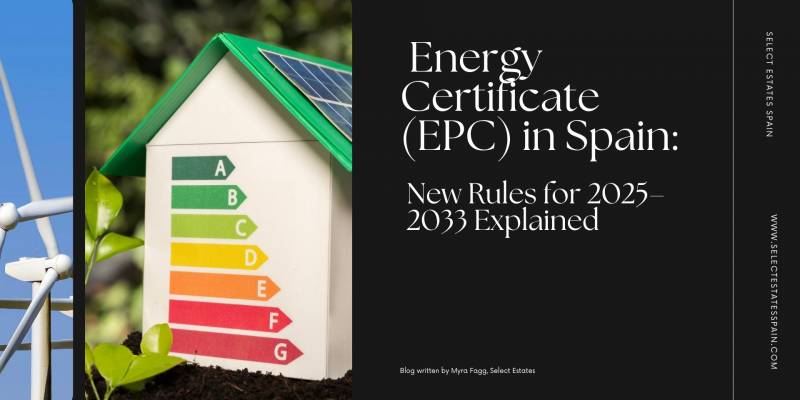
Energy Certificate (EPC) in Spain: New Rules for 2025–2033 Explained
If you are buying, selling, or renting property in Spain — including popular areas like the Costa Blanca and Murcia — understanding the energy certificate (EPC) is becoming more important than ever.
In recent years, regulations around energy efficiency have become significantly stricter, and this trend will continue in the coming decade.
In this guide, we explain the latest EPC rules in Spain, what is changing between 2025 and 2033, and what it means for property owners, buyers, and investors.
What Is an Energy Certificate (EPC) in Spain?
The Energy Performance Certificate (EPC) — known in Spain as the Certificado de Eficiencia Energética — measures how energy-efficient a property is.
Properties are rated on a scale from:
- A (very energy efficient) to G (very inefficient)
The certificate evaluates factors such as:
1. Insulation
2. Windows and materials
3. Heating and cooling systems
4. Energy consumption
An EPC is generally valid for 10 years and is legally required in several situations.
When Is an EPC Required in Spain?
An energy certificate is mandatory for:
- Selling a property
- Renting out a property
- Advertising a property (online or offline)
- Applying for a mortgage
This means that in practice, it is impossible to legally sell or rent a property without a valid EPC.
New Rule Since 2025: EPC Required for Mortgages
Since 2025, one major change has been introduced:
- A valid EPC is now required to obtain a mortgage
- Without an EPC, a property often cannot be officially valued (tasación)
- Without valuation → no mortgage approval
Practical impact:
Sellers must ensure the EPC is available before putting the property on the market.
For buyers, this means:
- Always check the EPC early in the process
- It can directly affect financing
2030: Minimum Energy Label E Required
One of the biggest upcoming changes is expected around 2030.
Properties will need to meet a minimum energy rating of E.
This means:
1. Homes with label F or G may no longer be sold or rented
2. Owners of older properties will likely need to renovate
Impact on the market:
- Older homes may lose value if not upgraded
- Renovated, energy-efficient homes will become more desirable
2033: Minimum Energy Label D
By 2033, regulations are expected to become even stricter.
The minimum requirement is expected to increase to:
Energy label D
This will lead to:
- More renovation demand
- Higher costs for non-updated properties
- Increased importance of energy efficiency in property valuation
Where Do These Rules Come From?
These changes are driven by the European Union’s Energy Performance of Buildings Directive (EPBD).
The goal is to:
1. Reduce overall energy consumption
2. Improve building efficiency
3. Achieve climate neutrality by 2050
Spain is implementing these goals through national legislation, which is why regulations are gradually becoming stricter.
What Does This Mean for Property Owners and Buyers?
Whether you are buying, selling, or investing in Spain, these changes have a direct impact.
- Important for Buyers
- Always check the EPC rating before purchasing
- Factor in potential renovation costs
- Lower-rated properties may seem cheaper but require investment
Important for Owners
1. Ensure your EPC is valid and up to date
2. Be aware that low-rated properties may become harder to sell
Smart Investments
Improving your energy rating can significantly increase your property value.
Key upgrades include:
- Insulation improvements
- Double or triple glazing
- Solar panels
- Heat pump systems
These upgrades can:
1. Increase property value
2. Improve saleability
3. Boost rental potential
Important Note: Regulations Are Still Evolving
Some of the future rules — especially the minimum labels for 2030 and 2033 — are still being finalized at policy level.
However, the direction is clear:
- Energy efficiency will become a key requirement in the Spanish property market.
- Waiting too long to adapt may result in higher costs later.
Summary: EPC Rules in Spain (2025–2033)
2025: EPC required for mortgage approval and property sales
2030: Expected minimum energy label E
2033: Expected minimum energy label D
Conclusion: Why EPC Matters More Than Ever
Energy efficiency is no longer just a “nice to have”, it is becoming a legal and financial requirement in Spain.
For buyers, it affects:
1. Financing
2. Renovation costs
3. Future resale value
For sellers, it determines:
- Whether a property can be sold or rented
- How attractive it is on the market
If you are active in the Costa Blanca or Murcia property market, understanding EPC regulations is essential to making smart, future-proof decisions.
Thinking About Buying or Selling Property in Spain?
Whether you are buying, selling, or investing, we guide you through every step — including checking legal requirements such as energy certificates and helping you understand the true value of a property.
Feel free to get in touch for tailored advice.